Linda Matthews
Curation as a form of drawing research gathers quietly, taking shape through the cross-conversation of artists, works, writing and thought. Testing the bounds of drawing, this practice proceeds iteratively, allowing meaning and knowledge to form gradually over time — still provisional, still forming.
Linda Matthews / DISRUPTING THE ARCHITECTURAL DRAWING
Linda Matthews is an Associate Professor in the School of Architecture and a Co-Director of the Visualisation Institute at the University of Technology, Sydney. Her research concerns architectural and urban design methodologies that utilise the optical logic of digital visioning systems. The work aims to use virtual urban spaces as a source of qualitative and quantitative data to generate non-traditional modes of architectural and urban form.
THINKING ON THE PAGE
by Belinda Yee
A drawing can do many things, too varied to summarise here, but it is always engaged in a process of unfolding itself in the world — a tentative proposition. A drawing serves as a means of thinking on the page, a circular process of externalising thought. This applies to visual art, architectural plans, 3D CAD/CAM models, and quick sketches. All are methods of externalising thought to test ideas in real time. As the hand moves to draw, the eye perceives, and the brain simultaneously understands, analyses, and proposes something anew. For the audience too, a drawing is a tentative proposition from which new thoughts emerge. Linda Matthews’ exhibition Disrupting the Architectural Drawing explores new modes of visualisation as a way of ‘thinking on the page,’ slicing and reconfiguring digital video data to reveal the affective potential of architectural drawing.
This process of thinking on the page is not lost in the transition from paper to digital, a shift that has occurred in every creative field. In architecture, this evolution from paper to pixels is illustrated by artist and author Peter Cook through two markedly different works. The first is Free Architecture: House for Three Families (1981) by Japanese architect Masaharu Takasaki — a coloured pencil drawing of free-form organic shapes that is distinctly hand-drawn and slightly surreal. In contrast, Cook presents the digital visions of the Morphosis practice, whose Rendering of Atrium Study, Cooper Union New Academic Building (2009) features computer-generated geometric forms, grids, shadows, and reflections floating over architectural plans in a lime green field.(1) These are clear signposts of the transition from pencil to keyboard as means of engaging with the world in architectural practice. Digital technologies have, over the last half century, enhanced productivity and improved the design process. Of greater interest here, however, is the way this transition has allowed architects to explore the inherent nature of digital technologies as form-giving, to work with the materiality of technology in real time, as a way of ‘thinking on the page.’ Linda Matthews works with digital tools and source information in this way.
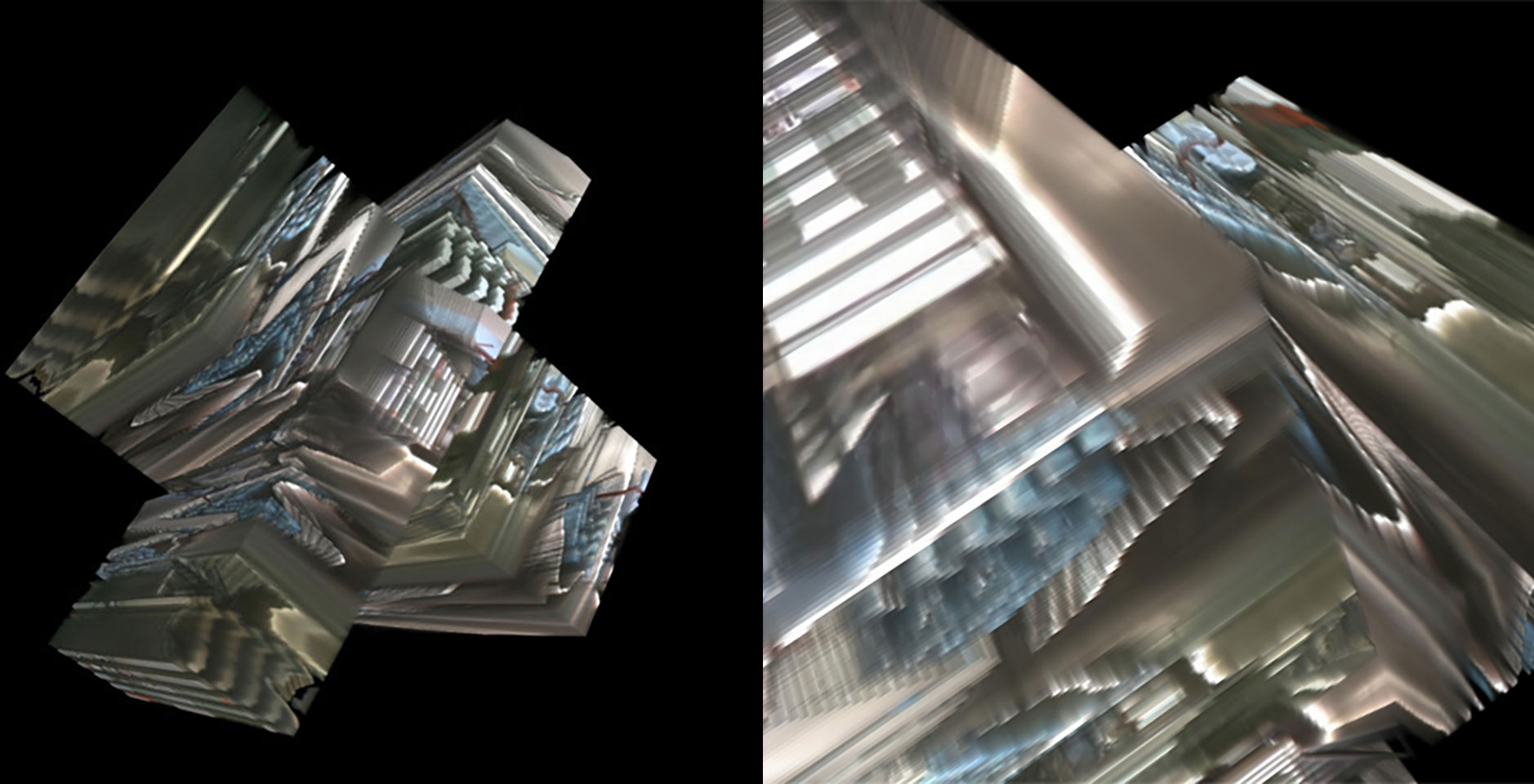
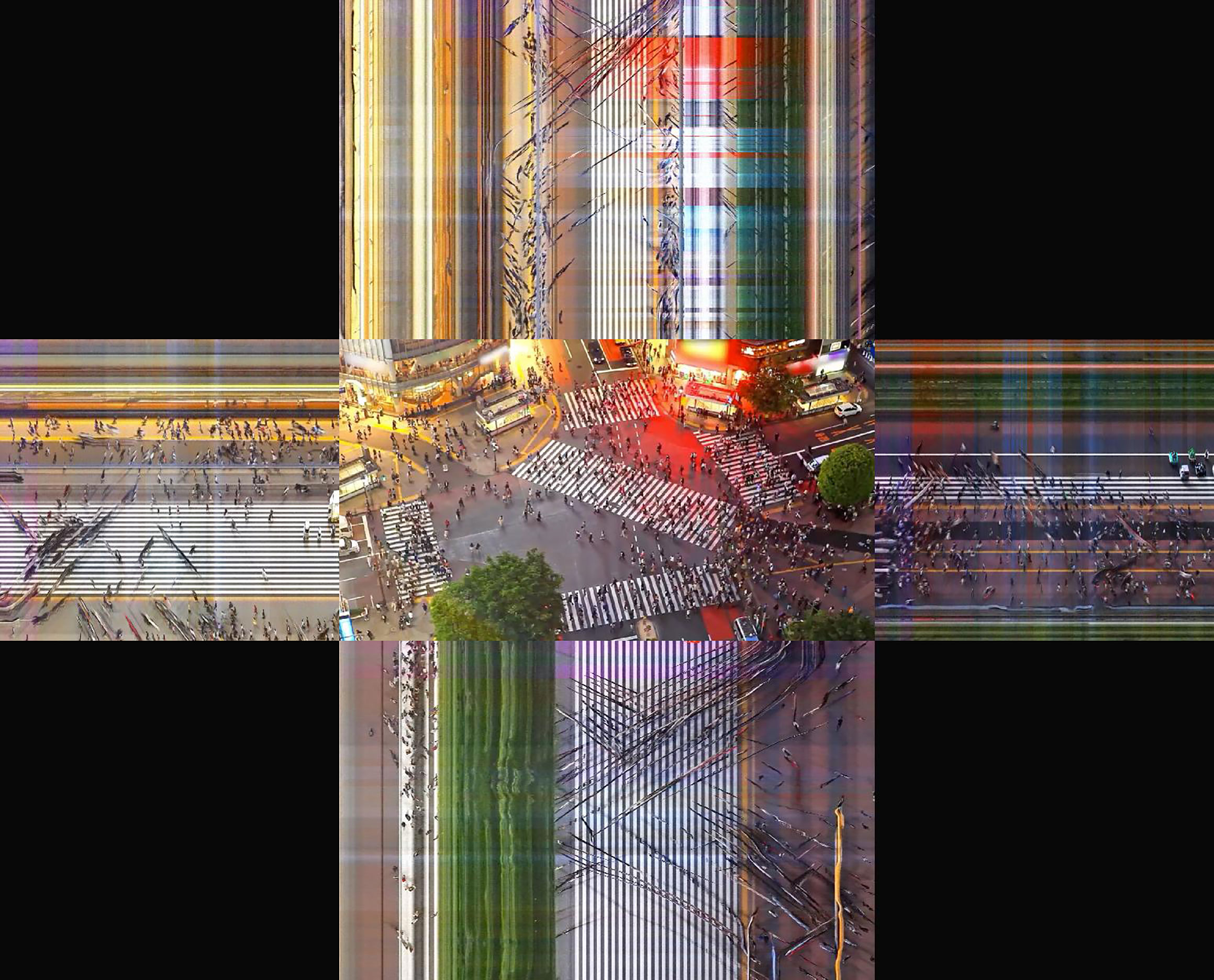
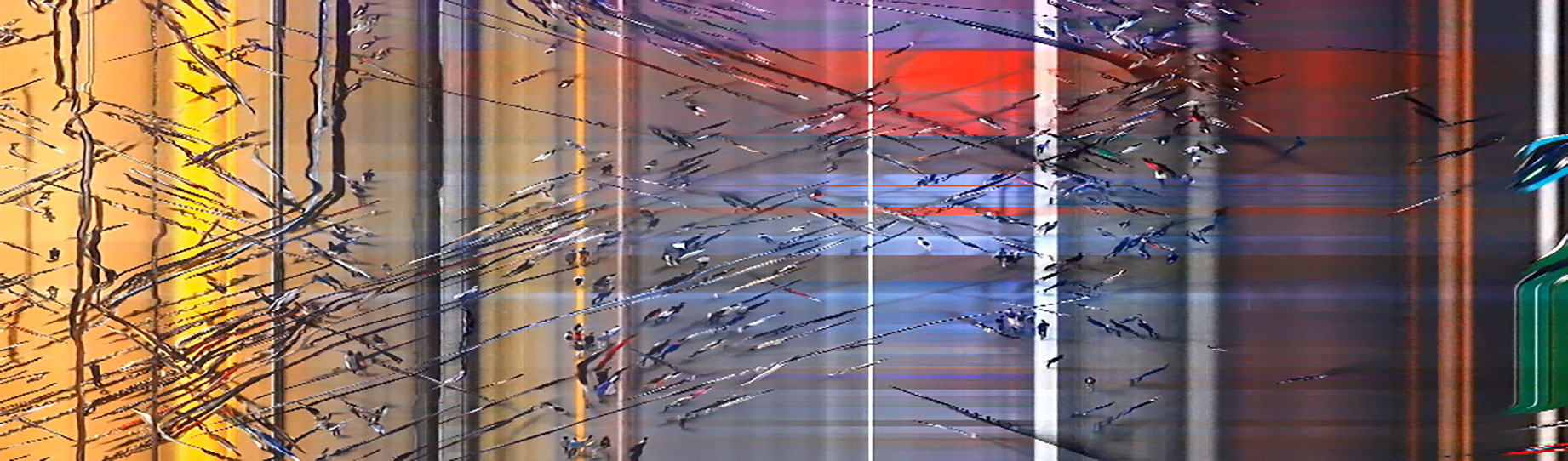
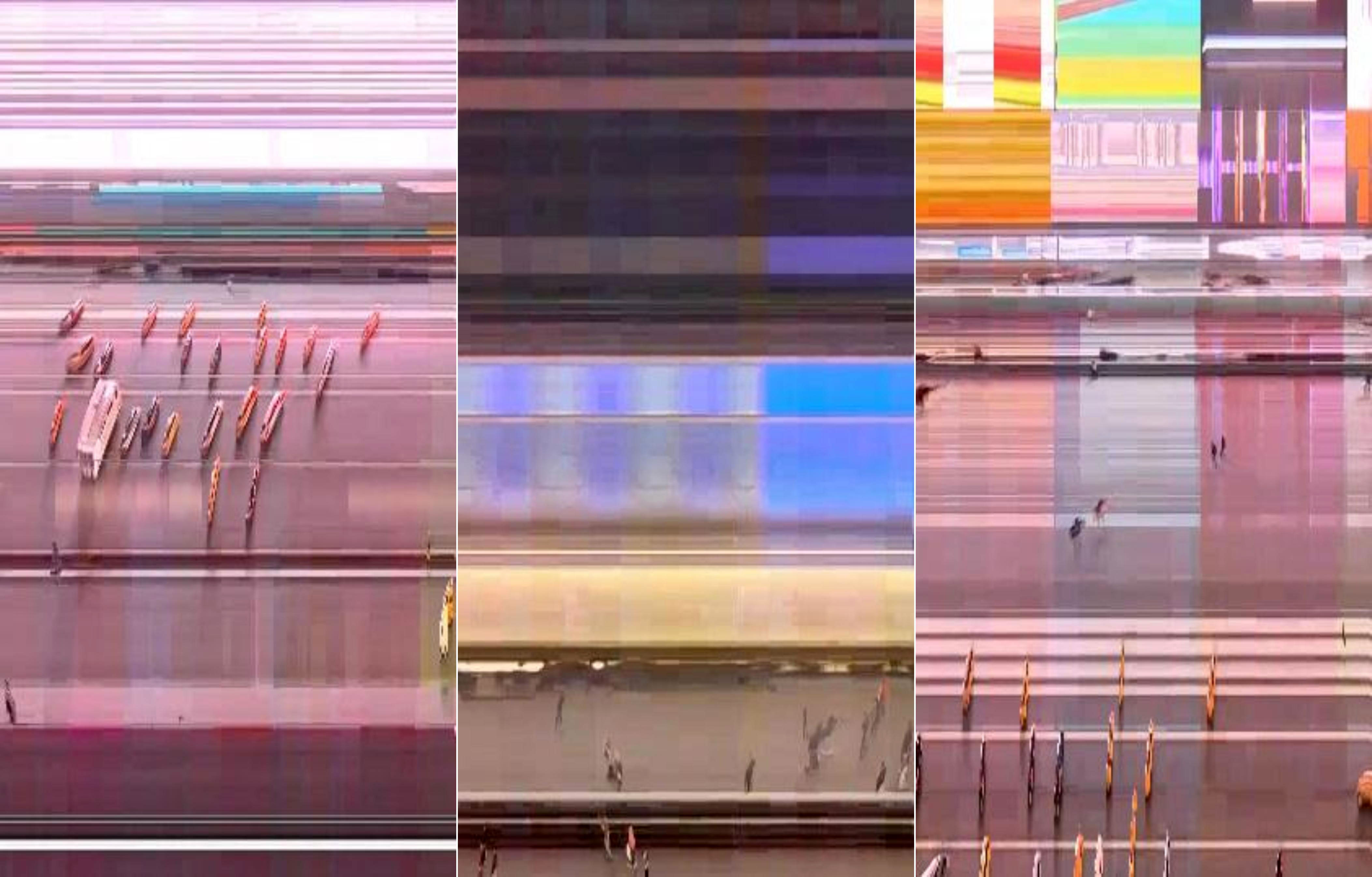
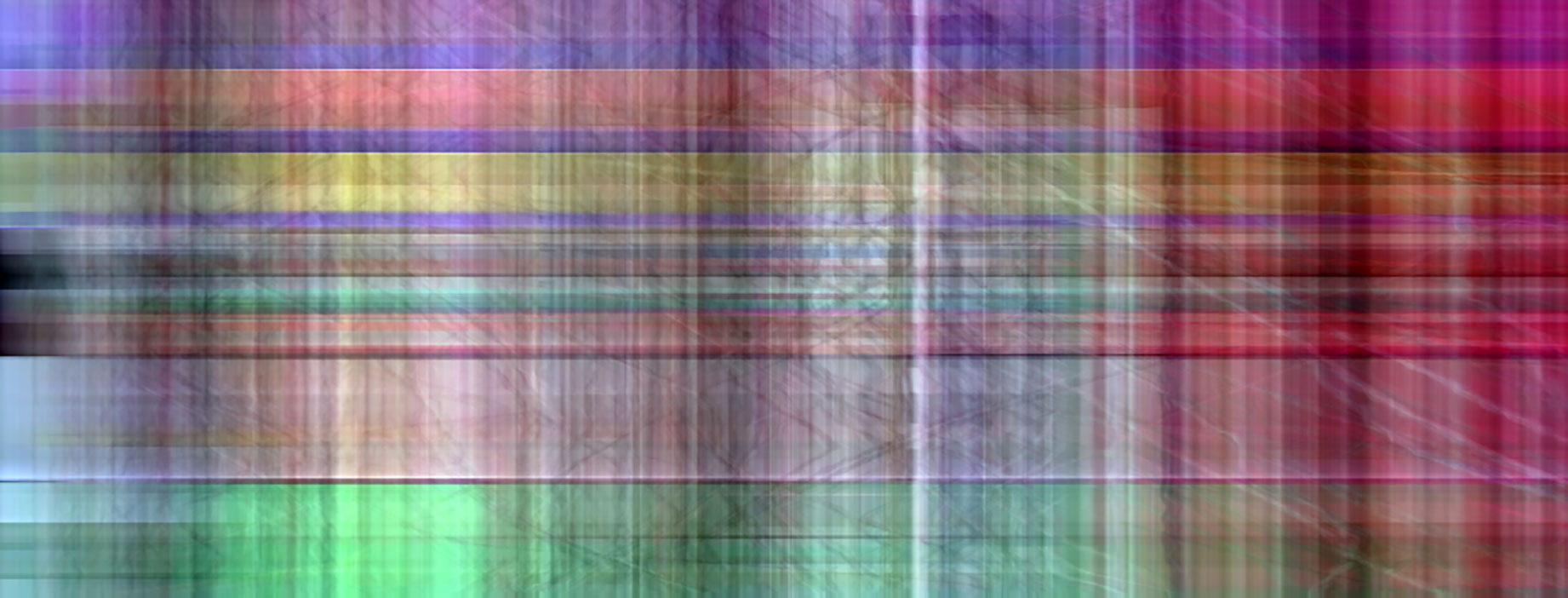
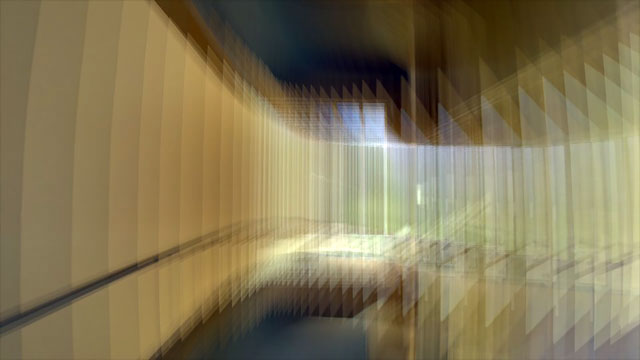
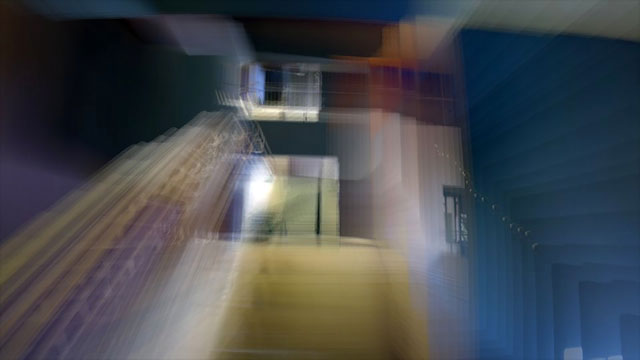
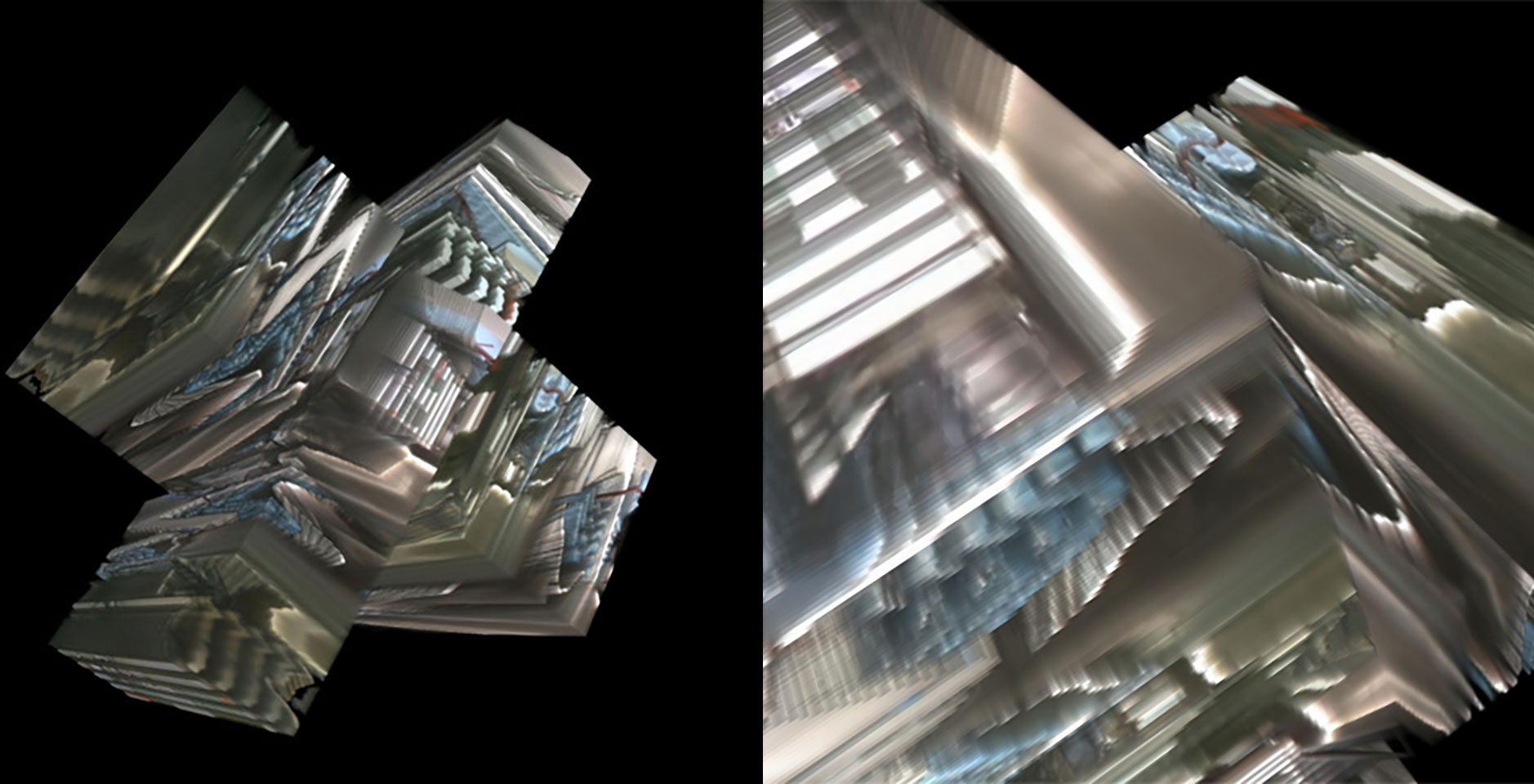
The work presented in the exhibition, Disrupting the Architectural Drawing is procedurally digital, that is, it is created through a systematic process involving digital tools and technologies. It is also concerned with the impact of the digital — how digital technologies and views of the built environment reveal and limit insights into how we live in urban spaces. Linda creates her work by reconfiguring webcam footage, stacking each frame from a linear video sequence into a three-dimensional digital cube. Each frame representing a moment in time shifts from being present for 1/24th of a second in a video clip, to being constantly visible or present in a temporally stratified spatial structure. In Linda’s work, temporal data becomes spatial data. Using diagnostic medical imaging technologies, Linda then slices through the video cube to reveal cross-temporal and cross-spatial representations of urban space and urban lives. This last stage mirrors the action of sectioning in more traditional forms of architectural drawing.
It is interesting to compare Linda Matthews’ space-time slices with other contemporary works. For example, Daniel Crooks’ Static No. 12 (seek stillness in movement) video is a complex composition of temporal sequences, some condensed and some stretched for effect.(2) This compositing technique has the effect of elongating figures to create a sense of stretched time. In contrast, Linda’s work maintains the fidelity of the original space-time video data without shuffling, stretching or compressing for effect. Through this approach, Linda’s images reveal the content of the original data, maintaining what is important to her as an architect: the relationship between objects and the built environment.
Linda’s work describes change — the small, continuous engagement of people in urban spaces. Her approach to sculpting meaning from space-time video data aligns more closely with conceptualisations of Block-Time theory in physics than the practice of her contemporaries in art. In Block-Time theory, time is structured as a cube, all of time always exists and the path of any individual moves like a single winding line through space-time.(3) If physicists created elevations, plans and sectional views through Block Time they might well see something akin to Linda Matthews’ work in this exhibition.
The works in the Disrupting the Architectural Drawing exhibition explore the affective nature of urban spaces through the qualitative and quantitative data contained in the original webcam and handheld video footage. Using brightness, colour and slicing through space-time, Linda Matthews reveals the way people live and use public areas. Skilfully navigating the collected video data, her works highlight the potential of drawing as a circular process of ‘thinking on the page,’ reveal new conceptualisations of space-time and extend our understanding of architectural drawing.
(1) Peter Cook, “Drawing and Image,” in Drawing: The Motive Force of Architecture (John Wiley & Sons, Incorporated, 2014), 74–91.
(2) Daniel Crooks, Static No. 12 (seek stillness in movement) 2009–10, high-definition digital video.
(3) In Block-Time Theory, also known as Block-Universe Theory, time does not flow. All time — past, present and future — already exists like stacked cards in a box. The perception of time flowing is created from the perspective we have as individuals, moving through the ‘stack of cards’ from one moment to the next. The similarity between Block Time and Linda Matthews’ work is that they both form time into blocks such that every moment is always existing. Linda Matthews’ work also presents the lived experience of ‘now’ for any individual as being both temporally and spatially located; this is the same for Block Time.
© 2024 Belinda Yee
For more information and to read Linda’s essay — DRAW Space